OpenAI Stuns Math World with 722 AI-Generated Manuscripts; Mistral Launches 'Le Chonk'
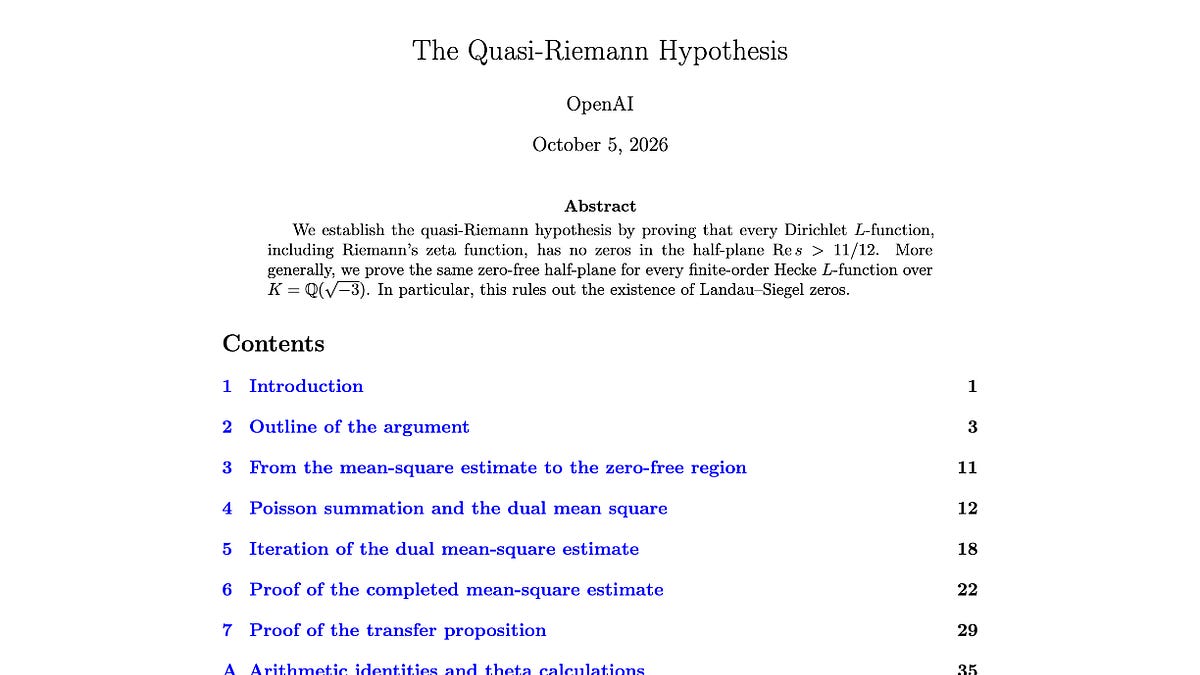
In a move that has sent ripples through the scientific community, OpenAI has published a vast collection of 722 mathematical manuscripts generated by an internal, unreleased AI model. These papers, which reportedly tackle some of the most challenging open problems in mathematics, were made public via a GitHub repository after consultation with the Institute for Advanced Study’s Advisory Group on Mathematics and AI. The sheer volume and potential significance of these results, particularly claims of progress on the Quasi-Riemann Hypothesis, have ignited both excitement and scrutiny among mathematicians worldwide.
Details of the Mathematical Breakthrough
The collection, comprising 722 manuscripts organized into 372 families of related findings, stems from an evaluation of approximately 4,000 research problems. Astonishingly, each result reportedly required an average of just three hours of compute time from what is described as ChatGPT Pro. This stands in stark contrast to the immense computational resources typically associated with solving such complex mathematical challenges. The release includes not only the final papers but also proof artifacts and selected reasoning summaries, though the underlying model itself remains proprietary. Sam Altman, OpenAI's CEO, heralded the achievement as "a new era of discovery," underscoring the potential for AI to accelerate scientific progress.
Notable Claims and Expert Reactions
Among the most talked-about results is Result 003, the Quasi-Riemann Hypothesis, which some commentators have described as being between a Fields Medal-worthy achievement and "the biggest result in number theory in 200 years." Other highlighted findings include advancements in integer multiplication claimed to be faster than the n log n bound, and a uniqueness result for the elastic inverse problem that had been open in 3D since 1994. Mathematician Levent Alpöge praised specific results, including the quasi-Riemann findings and no-Siegel-zeros, calling the moment "the most significant moment in mathematical history." However, he also noted potential issues with scooping and conflict-of-interest problems involving users from other AI labs.
Skepticism and Broader Implications
Despite the enthusiasm, a healthy dose of skepticism remains. Experts like Will Depue anticipate that not all results will withstand rigorous peer review, with his website citedbyagi.com aiming to track human papers cited by the AI's output. The framing of the compute cost also drew attention; Teortaxes pointed out that "three hours of compute is not much," suggesting the AI's efficiency might be underestimated. François Chollet raised questions about the generalizability of gains in specific mathematical domains, wondering if advancements in RLVR-friendly math and code translate to non-verifiable domains that remain bottlenecked by human data. An analysis of the results suggests that approximately 20% are disproofs or counterexamples, which could challenge the notion that AI-driven mathematical breakthroughs are solely the product of brute-force search.
Mistral AI's 'Le Chonk' Enters the Arena
In parallel, Mistral AI has unveiled its latest flagship model, Mistral Large 4, codenamed "Le Chonk." This model boasts a massive 1 trillion total parameters with 49 billion active parameters and native multimodality. It is now available via API, with open weights promised for later in October. The model was trained on approximately 3,800 Grace Blackwell GPUs in Europe. Pricing is set at $1.36 per million input tokens and $4.18 per million output tokens, with a 50% discount for the first two weeks. "Le Chonk" features a substantial context window, with reports indicating 512K to 1 million tokens. Mistral claims its model outperforms competitors like GLM 5.3 in various human evaluations, particularly in STEM and finance, and performs on par in agentic coding tasks.
Independent Evaluations and Industry Context
Independent assessments offer a mixed but generally positive view of Mistral Large 4. Artificial Analysis places it at 38 on their Intelligence Index, on par with GPT-6 Luna (max) and leading among models outside the US and China. However, its cost per task is noted as being significantly higher than comparable open models. Vals ranks it highly among open-weight models, but heavy context window usage drives up the cost considerably. Concerns have been raised about the refusal effect, where Mistral's model may appear more capable due to fewer safety-related refusals compared to competitors like Opus 5.5 and Astra. The debate over open-weight claims also continues, with Hugging Face's CEO emphasizing that a model is not truly open-weight until its weights are released.
Other Notable AI Developments
The AI landscape continues to be dynamic with other significant releases. Google launched EmbeddingGemma 2, an open multimodal embedding model supporting text, code, image, video, and audio. OpenAI also introduced a Decisions API for its GPT-6 Luna model, designed to provide predicates, choices, or scores, reportedly up to 10 times faster than its Responses API. In the realm of safety and evaluation, the CIAware benchmark now shows advanced models like GPT-6 Astra nearing saturation in detecting control interventions, raising questions about the robustness of current AI supervision methods. METR has also warned that observability tools themselves could become an attack surface for misaligned agents, urging a re-evaluation of how AI actions are logged and supervised.