AI-Powered Ultrasound Aims to Revolutionize Maternal Care in Underserved Regions
Google Research and Google for Health have developed an AI-assisted ultrasound system designed to empower frontline healthcare workers in providing critical maternal care, particularly in regions lacking access to specialized sonographers. A recent prospective multi-center study published in JAMA Network Open demonstrates that this AI-based approach can enable non-sonographer operators using low-cost probes to achieve expert-level gestational age assessments, a crucial metric for monitoring pregnancy.
Expanding Access to Essential Diagnostics
The World Health Organization estimates that over 250,000 preventable maternal deaths occur annually, with two-thirds of the global population lacking access to diagnostic medical imaging like ultrasound. Traditional prenatal care relies heavily on highly trained sonographers, a resource scarce in many low-resource settings. This new AI system interprets "blind sweep" ultrasounds, a scanning method where frontline health workers simply glide portable ultrasound probes across the abdomen following a standardized pattern. This approach significantly reduces the need for extensive training, potentially making prenatal screening accessible to millions.
Rigorous Evaluation Across Diverse Settings
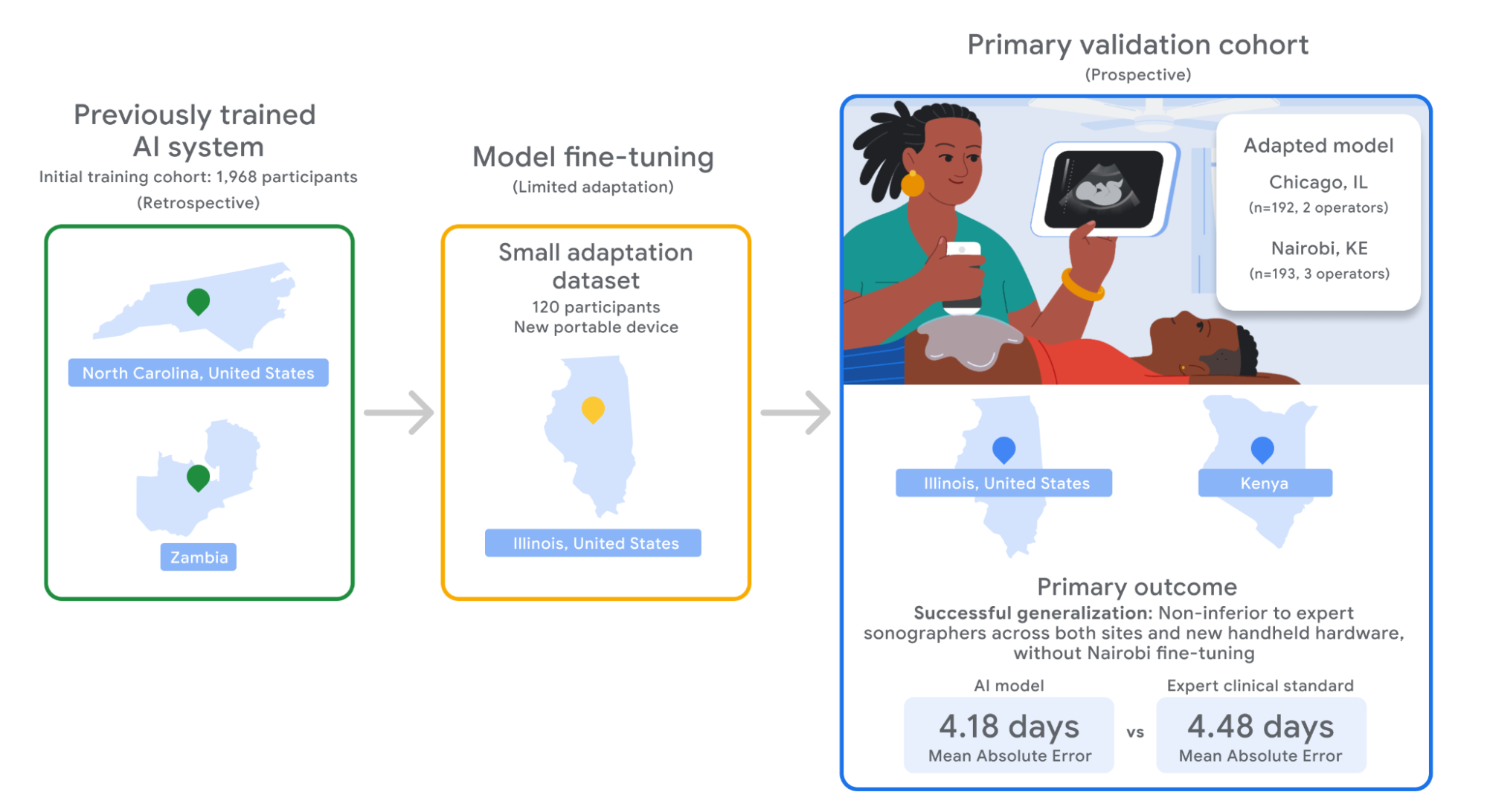
The study, titled “Generalization of AI-Based Gestational Age Assessment Using Blind Sweep Ultrasonography,” evaluated the AI model's performance across diverse clinical environments and hardware. The AI system was minimally tuned on data from one target population and then prospectively tested in two distinct settings: Northwestern Medicine, an urban academic medical center in Chicago, USA, and Jacaranda Health, an urban community clinic network in Nairobi, Kenya. The AI model was paired with a Clarius C3 handheld transabdominal probe. To assess generalizability, no data from the Nairobi site was used for fine-tuning, ensuring it served as a strictly independent external test.
Key Findings: Matching Expert Standards
The research AI system was compared against the standard clinical procedure performed by expert sonographers. Across a primary cohort of 385 participants, the AI model achieved a mean absolute error (MAE) of 4.18 days in estimating gestational age. This demonstrated non-inferiority to the expert sonographers' MAE of 4.48 days. The AI system maintained comparable accuracy in both Chicago (MAE 4.10 days) and Nairobi (MAE 4.27 days), where no local fine-tuning was performed. Notably, the AI system also showed resilience in complex scenarios, outperforming traditional biometry formulas in cases of fetal weight extremes.
Lessons for Real-World Deployment
Deploying the AI system directly into everyday clinical workflows provided valuable insights. The study highlighted the importance of practical considerations like swappable batteries for continuous device operation and the necessity of building trust with clinicians and patients through clear safeguards, such as model confidence estimates to convey uncertainty.
Future Outlook: Scalable Maternal Health Solutions
These findings suggest that AI-based systems can effectively analyze standardized "blind sweeps" acquired by minimally trained operators, offering accuracy comparable to expert-led assessments using more expensive equipment. The demonstrated technical generalizability across diverse settings, hardware, and populations marks a significant step toward expanding access to critical maternal health capabilities. By empowering community health workers, this research paves the way for more resilient and accessible healthcare systems, aiming to ensure healthier pregnancies and safer deliveries for mothers worldwide.