Germany Taps NVIDIA for AI Industrial Revolution, Pledges National Integration
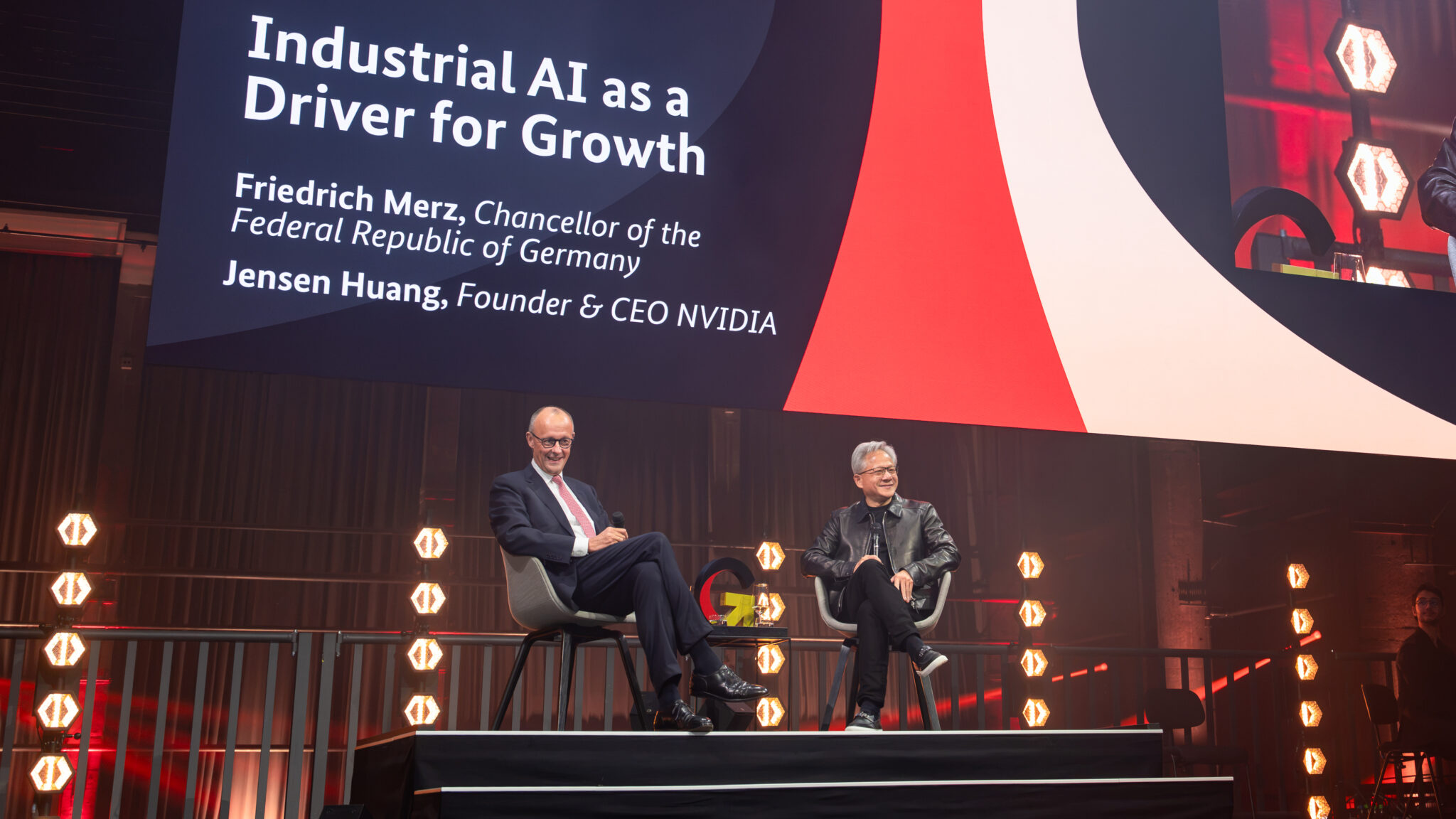
German Chancellor Friedrich Merz and NVIDIA founder and CEO Jensen Huang convened in Berlin to chart a course for Germany's AI future, with a particular emphasis on leveraging artificial intelligence within the nation's robust industrial and manufacturing sectors.
NVIDIA's long-standing relationship with German industry, which began in the early 2000s with gaming and automotive design, has evolved into current partnerships focused on autonomous vehicles and digital twins for manufacturing. The discussion centered on how Germany can capitalize on the AI revolution by reinforcing its strengths in manufacturing and automotive industries, while simultaneously fostering AI adoption across its extensive network of small and medium-sized enterprises (SMEs), known as the Mittelstand.
Earlier in the day, as part of the Invest in Germany Summit, Chancellor Merz, alongside the Federal Ministry for Economic Affairs and Energy and the Federal Ministry for Research, Technology and Space, signed a Joint Declaration of Intent with NVIDIA. This agreement signifies a commitment to a collaborative initiative aimed at advancing cutting-edge AI models for physical AI applications. The declaration formalizes and expands NVIDIA's cooperation with Germany's federal government and its "Industry 4.0 Platform," a coalition representing politics, industry, research, and trade associations. The overarching goal is to "systematically bring industrial AI into widespread use and to establish a state-of-the-art industrial AI ecosystem in Europe."
Germany's Ambition for Industrial AI Leadership
Chancellor Merz articulated Germany's clear ambition: "We are fully committed to be one of the most advanced places in the world, not just in the European Union, but in the world to work with AI, to integrate AI into our industry." He expressed optimism that Germany could become a leading country in the widespread application of AI across its manufacturing, machinery, and automotive sectors. Merz specifically addressed the Mittelstand, urging these companies to "open your doors for AI to make use of your data," highlighting it as a significant advantage for Germany.
Jensen Huang echoed this sentiment, praising Germany's world-class manufacturing expertise and its excellence in mathematics and science. He emphasized that AI will serve to augment, not replace, these inherent capabilities. "That knowledge belongs to you," Huang stated. "It cannot be replaced. AI can only augment your capability, it will not replace your capability. Take advantage of the technology. It’s a new instrument."
Both leaders agreed that Germany's deep expertise in physical technologies, when combined with AI, presents a powerful catalyst for economic growth. Merz envisioned a future where Germany could be "one of the most successful economies in the world" by successfully integrating these two domains. Huang characterized AI's impact as a new industrial revolution, urging Germany to "re-engineer Germany" effectively.
NVIDIA's European Investment and German Startup Support
As part of its broader commitment to Europe, NVIDIA announced new investments in four German startups: Agile Robots, Avelios Medical, Mirelo, and Reflex Aerospace. These investments are part of NVIDIA's nearly $10 billion commitment to support companies, universities, and research institutions across Europe. Agile Robots develops AI-powered robots for manufacturing, logistics, and healthcare. Avelios Medical is creating an AI-native hospital information system to streamline clinical and administrative workflows. Mirelo focuses on AI models for generating audio content for video production, while Reflex Aerospace designs high-performance satellites.
Advancements in Autonomous Manufacturing and Quantum Simulation
In parallel, Siemens announced a partnership with NVIDIA to advance AI-driven autonomous factories. Siemens showcased new AI solutions at its Erlangen factory, demonstrating how fully virtual production ramp-ups can reduce engineering effort by up to 85% and how agent-based production planning can enable more adaptive manufacturing with cost savings of up to 20%. Additionally, NVIDIA researchers utilized JUPITER, Europe's largest supercomputer, to achieve a record-breaking simulation of a fault-tolerant quantum computer, simulating 104 qubits in the largest and most detailed simulation of its kind to date.